
Modeling the Consolidation Process of Thermoplastic Composites

From raw unidirectional tapes to lightweight structural components: Can computer-aided modeling accurately predict the quality and structural integrity of continuous fiber-reinforced semi-finished products before they hit the factory floor?
To address this challenge, the Competence Center CHASE, alongside an international consortium of industrial and scientific partners, developed an advanced numerical simulation framework. By capturing complex thermodynamic and rheological phenomena in real time, the project successfully demonstrated that digital process design can drastically optimize the consolidation of thermoplastic composites, enhancing material, time, and energy efficiency.
The Rise of Thermoplastic Matrices in Composite Engineering
Continuous fiber-reinforced composites with a thermoplastic matrix have seen exponential adoption across high-performance sectors like aerospace and automotive engineering. Compared to traditional thermoset composites, thermoplastics offer distinct mechanical and operational advantages: excellent weight-to-strength ratios, short processing cycle times (since the matrix polymer requires no crosslinking or curing), potential for back-injection functionalization, and inherent mechanical recyclability.
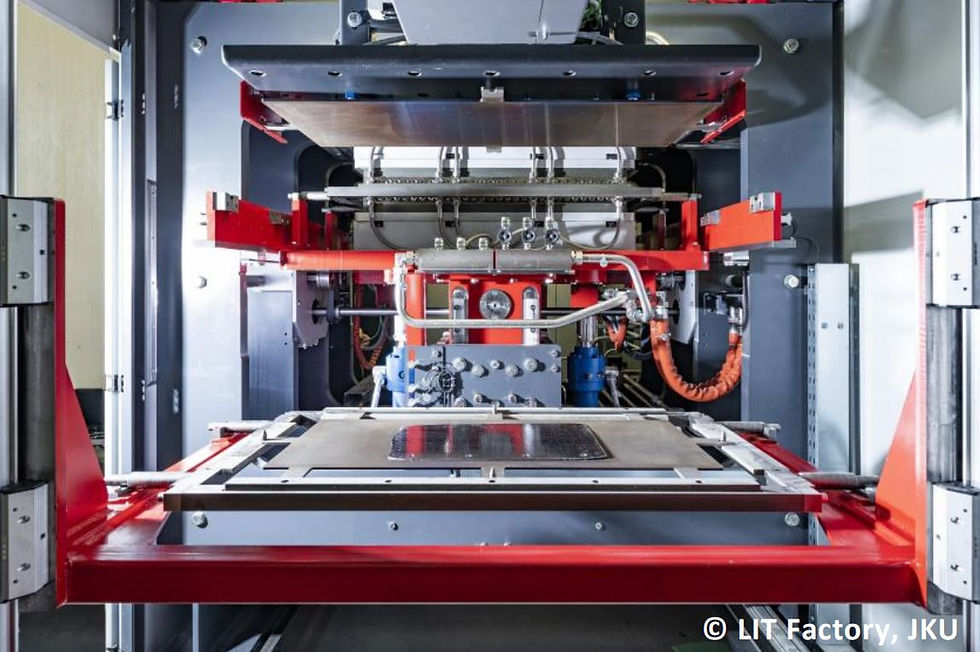
However, fabricating these multi-layered, semi-finished sheets requires a precise consolidation process. A layup of several unidirectional (UD) tapes must be compressed between carrier tools under specific pressure and temperature profiles to achieve a flawless material bond. Uncontrolled variations in these process parameters can result in hidden structural defects or geometric inaccuracies.
The Three Critical Pillars of Consolidation Modeling
To establish a reliable predictive model, the research team focused on the interaction of three core physical phenomena that govern final product quality:
Time-Dependent Thermodynamic Behavior: Because thermoplastic material properties are highly temperature-dependent, capturing the transient heat transfer between the heating/cooling presses, the carrier tools, and the embedded tape layup is central to predicting the entire process dynamics.
Interfacial Bond Quality: The consolidation framework must accurately simulate the autohesion and macromolecular diffusion occurring between the individual UD tape layers under pressure to guarantee optimal interlaminar shear and bond strength.
Anisotropic Squeeze Flow and Geometry Alterations: Under high pressures and temperatures, the polymer matrix melts and undergoes squeeze flow. Modeling this flow behavior is crucial because it directly alters the final dimensions and fiber alignment of the semi-finished composite sheet.

Numerical Architecture and Multi-Scale Empirical Validation
The computational framework was engineered by adapting an existing solver within the open-source CFD platform OpenFOAM®. This custom solver was specifically tailored to simulate the precise heat transfer profiles and material kinetics during the press cycle.
To ensure industrial viability, the simulation was validated across two distinct experimental scales:
Laboratory-Scale Investigations: Used primarily for foundational research into the mechanics of anisotropic squeeze flow and localized fiber orientation.
Industrial-Scale Press Facilities: Deployed to validate the solver’s applicability to real-world production environments, confirming that the digital twin can handle large-scale, complex thermal and physical processing boundaries.
Empirical Results: High-Fidelity Quality Predictions
The empirical validation demonstrated outstanding alignment between the numerical models and physical experiments. The developed OpenFOAM® approach provided highly accurate temperature mapping at various internal coordinates of the tape layup throughout the entire consolidation cycle.
Furthermore, the simulation achieved excellent agreement with physical test samples regarding squeeze flow characteristics and final part geometry. Crucially, comparisons with mechanical destructive testing proved that the model can reliably predict internal bond strength based purely on process parameter inputs (temperature, pressure, and time).
By replacing trial-and-error physical prototyping with accurate, physics-based simulations, manufacturers can now optimize their composite processing lines digitally—minimizing scrap rates, reducing energy expenditure, and accelerating time-to-market for next-generation lightweight materials.
Project partners
The work was carried out by Competence Center CHASE GmbH ↗, Johannes Kepler University Linz ↗, Covestro ↗, ENGEL Austria ↗, and FACC ↗.
Read the Success Story: Modeling the consolidation process of thermoplactic composites ↗


Comments